To further strengthen the implementation of this policy, the Department issued DepEd Order No. 12, s. 2014, entitled Implementing Guidelines on the Direct Release of Maintenance and Other Operating Expenses (MOOE) Allocations of Schools to the Respective Implementing Units. Signed by then Secretary Br. Armin A. Luistro, FSC, the Order prescribed the operational requirements for schools designated as Implementing Units (IUs).
Under the said guidelines, schools may be classified as Implementing Units provided they possess the organizational capability to administer public funds. Specifically, an Implementing Unit must have plantilla positions assigned to perform bookkeeping and cashiering functions, whether on a permanent or temporary basis. It is likewise required to maintain a Modified Disbursement System (MDS) Sub-Account with an authorized government depository bank and to keep a complete set of books of accounts in accordance with applicable government accounting, budgeting, auditing, and treasury regulations. Cash allocations intended for these schools are downloaded directly by the DBM to their respective MDS Sub-Accounts, thereby making the school directly accountable for the management, utilization, recording, reporting, and liquidation of public funds.
Within the Department of Education, public schools are generally classified into two categories with respect to fiscal management: Implementing Units (IUs) and Non-Implementing Units (Non-IUs).
Implementing Units are schools that maintain separate books of accounts, operate their own MDS Sub-Accounts with government depository banks such as the Land Bank of the Philippines, and receive direct releases of budget allocations from the Department of Budget and Management pursuant to appropriations authorized under the General Appropriations Act (GAA). They are responsible for the complete cycle of financial management, including budgeting, accounting, disbursement, financial reporting, and compliance with government fiscal regulations.
In contrast, Non-Implementing Units do not maintain separate accounting records or MDS Sub-Accounts. Instead, they receive operating funds through the Schools Division Office under a cash advance and replenishment mechanism, whereby subsequent releases are made only after the liquidation of previously released funds.
Similarly, the Central Office, Regional Offices, and Schools Division Offices of the Department are likewise classified as Operating Units or Implementing Units because they independently administer government appropriations and maintain separate accounting and financial reporting systems.
Most public secondary schools designated as Implementing Units are staffed by only two finance personnel: a Senior Bookkeeper and a Disbursing Officer II. In actual practice, however, these two positions perform functions that extend far beyond the scope originally contemplated under their respective position classifications.
The Senior Bookkeeper performs responsibilities ordinarily discharged by an accountant, budget officer, financial analyst, and internal fiscal controller. The position prepares and maintains accounting records, oversees budget execution, prepares financial statements and budget reports, monitors allotments and obligations, ensures compliance with the requirements of the Commission on Audit (COA), the Department of Budget and Management (DBM), the Bureau of the Treasury (BTr), and the Department of Education, and provides financial advice to the School Head on matters affecting fiscal management and budget utilization.
On the other hand, the Disbursing Officer II serves as the school's cashier, disbursing officer, and collecting officer, ensuring that all cash transactions are properly processed, safeguarded, and reported in accordance with government accounting and treasury regulations.
Despite the highly technical and fiduciary nature of these responsibilities, the plantilla positions of Senior Bookkeeper and Disbursing Officer II remain classified at salary grades intended for first-level, non-supervisory personnel. Nevertheless, these personnel are entrusted with the administration and accountability of millions of pesos in public funds consisting of Personnel Services (PS), Maintenance and Other Operating Expenses (MOOE), School-Based Management grants, Special Purpose Funds, and other government financial assistance downloaded directly to schools. In many instances, the total annual budget administered by a single Implementing Unit exceeds ₱10 million, while larger secondary schools manage substantially higher appropriations.
The disparity between the official position classifications and the actual scope of responsibilities assigned to Senior Bookkeepers became increasingly evident as the fiscal decentralization program matured. While the authority, accountability, and complexity of financial management functions continued to expand, the organizational structure, career progression, and compensation of school finance personnel remained largely unchanged.
It was this growing disparity that became the catalyst for the organization of Senior Bookkeepers assigned in Implementing Units across the country. Recognizing their shared responsibilities, common operational challenges, and the absence of an institutional body to represent their professional interests, they began establishing networks and collaborating on issues affecting school financial management, professional development, and policy advocacy.
These collective efforts eventually paved the way for the formation of what is now known as the National DepEd Senior Bookkeepers Association (NDSBA)—a national organization committed to promoting professional excellence among school finance personnel, strengthening fiscal governance in public schools, and advocating for organizational reforms, equitable career progression, and the recognition of the vital role performed by Senior Bookkeepers in the effective implementation of basic education programs.
For the information of the reader, the DepEd has two (2) classifications of schools as to fiscal management. These are the so called Implementing Units and Non-Implementing Units. The Implementing Units refers to public secondary schools which maintain separate books of accounts wherein they have a separate Modified Disbursement Scheme (MDS) Sub-Accounts in a government depository bank like Landbank of the Philippines, and is receiving direct downloading of funds from the Department of Budget and Management since they have a separate funding as shown in the General Appropriations Act. Non-Implementing units receives their fund from the Division Office through a monthly cash advance scheme and the fund will be replenished upon liquidation of the previously released cash advance. In general, in the Department of Education, the Central Office, the Regional Offices and the Schools Division Offices are also categories as Operating Units (OU) or Implementing Units (IU).
The Secondary Schools are eligible to become an Implementing Units when it has financial staffs that are composed of a Senior Bookkeeper and a Disbursing Officer II. The Senior Bookkeeper acts and functions as the school accountant and at the same time the budget officer while the Disbursing Officer II acts as a cashier and collecting officer. Those personnel are tasks to entirely manage the fiscal responsibility and accountability of the school despite its level 1 qualification for the functions that supposed to be assigned to level 2 positions. This does not consider the amounts that are allocated to the particular Implementing Unit and since it is composed of the regular and special purpose fund allocation for Maintenance and Other Operating Expenses (MOOE) and Personnel Services (PS), the amount herein is at a minimum of Ten (10) million.
Due to the fact that the school fiscal responsibility is being managed by merely a Senior Bookkeeper who is functioning as the accountant and budget officer at the same time, with a low salary grade equivalent to non-managerial and non-supervisory positions under the Civil Service Law of which the functions requires a managerial and supervisory accountability and responsibility.
The Birth of the National DepEd Senior Bookkeepers Association
The Emergence of a Unified Voice for School Finance Professionals
The implementation of fiscal decentralization in the Department of Education (DepEd) fundamentally changed the landscape of financial management in public secondary schools. As more schools were designated as Implementing Units (IUs), the responsibilities entrusted to Senior Bookkeepers expanded far beyond the traditional bookkeeping functions originally contemplated under the existing organizational structure.
Senior Bookkeepers assigned in Implementing Units became directly responsible for maintaining the accounting records of their respective schools, preparing financial statements and budget reports, monitoring budget utilization, ensuring compliance with accounting and auditing laws, and assisting School Heads in the prudent management of government resources. Together with the Disbursing Officers, they became the principal custodians of school financial operations and accountability.
Despite these expanded responsibilities, Senior Bookkeepers remained classified under plantilla positions whose compensation and career progression no longer reflected the complexity and level of accountability demanded by the fiscal decentralization program. While the volume of government funds directly administered by schools continued to increase each year, the organizational support, professional recognition, and career development opportunities available to school finance personnel remained limited.
These realities gave rise to a growing desire among Senior Bookkeepers to establish a professional organization that would serve as a venue for collaboration, continuing professional development, and policy advocacy.
Building Professional Networks
During the early years of the implementation of the Implementing Unit system, Senior Bookkeepers from different Schools Division Offices began communicating with one another through seminars, capability-building activities, regional consultations, and various financial management conferences conducted by the Department of Education and other government agencies.
These interactions enabled finance personnel from different parts of the country to exchange experiences, discuss common operational issues, and share best practices in government accounting, budgeting, treasury operations, and financial reporting.
Although they came from different regions, they discovered that they were facing remarkably similar challenges. Among these were the continuously increasing workload, the absence of a clear career progression system, the disparity between their official position descriptions and their actual responsibilities, limited training opportunities specifically designed for school finance personnel, and the lack of a national organization that could represent their interests before the Department of Education, the Department of Budget and Management, the Civil Service Commission, and other government agencies.
As communication among Senior Bookkeepers became more frequent, informal professional networks gradually developed. These networks became valuable platforms for technical consultation, peer learning, and mutual support in addressing the day-to-day complexities of school financial management.
The Need for a National Organization
The continuing evolution of fiscal management in public schools underscored the necessity of creating a formal organization dedicated exclusively to Senior Bookkeepers assigned in Implementing Units.
Unlike other professional groups within the Department of Education that already had established associations representing their respective fields, Senior Bookkeepers had no unified national body that could advocate for their welfare, professional development, and institutional concerns.
The absence of such an organization became increasingly evident as new government policies, accounting standards, auditing requirements, procurement laws, and budgeting regulations continued to reshape the responsibilities of school finance personnel. While these reforms enhanced accountability and transparency in public financial management, they also required greater technical competence, continuous learning, and stronger institutional support.
Recognizing these realities, several Senior Bookkeepers from different regions initiated discussions on the possibility of organizing a national association that would unite all Senior Bookkeepers assigned in Implementing Units under a common vision.
The envisioned organization was not merely intended to promote camaraderie among its members. More importantly, it sought to become a professional institution committed to advancing excellence in school financial management, strengthening ethical standards, enhancing technical competencies, and serving as a constructive partner of the Department of Education in improving fiscal governance.
The Formal Organization
Through the collective efforts of pioneering Senior Bookkeepers from various Schools Division Offices, the vision of establishing a national organization gradually became a reality.
Series of consultations, organizational meetings, and discussions were conducted to define the objectives, organizational structure, and guiding principles of the proposed association. These consultations emphasized that the organization would be non-political, non-profit, and professional in character, dedicated to promoting competence, integrity, accountability, and transparency in the management of public funds entrusted to Implementing Units.
It was during this period that the National DepEd Senior Bookkeepers Association (NDSBA) was formally organized to serve as the official national organization of Senior Bookkeepers assigned in DepEd Implementing Units.
The establishment of the Association marked a significant milestone in the history of school financial management in the Department of Education. For the first time, Senior Bookkeepers across the country were united under one organization committed to advancing their profession while supporting the Department's commitment to good governance, fiscal responsibility, and quality public service.
The Founding Vision
From its inception, the Association envisioned a professional community of competent, ethical, and service-oriented school finance practitioners who would continuously contribute to strengthening public financial management in basic education.
Its founders recognized that effective fiscal governance begins with competent and accountable financial personnel at the school level. Consequently, the Association committed itself to promoting continuous professional development, knowledge sharing, policy research, and collaborative engagement with national government agencies in pursuit of reforms that would benefit both school finance personnel and the learners they ultimately serve.
More than an organization established to address employment concerns, the National DepEd Senior Bookkeepers Association was founded upon the principle that strengthening the competence, integrity, and welfare of school finance professionals is indispensable to ensuring the transparent, efficient, and accountable utilization of public resources for Philippine basic education.
The Birth of the National DepEd Senior Bookkeepers Association
The Emergence of a Unified Voice for School Finance Professionals
The implementation of fiscal decentralization in the Department of Education (DepEd) ushered in a new era in the management of public school finances. As more secondary schools were designated as Implementing Units (IUs), Senior Bookkeepers assumed broader responsibilities that extended well beyond the traditional scope of bookkeeping. They became responsible for government accounting, budget execution, financial reporting, compliance with national fiscal policies, and the overall financial stewardship of their respective schools.
Despite the increasing complexity of their duties, Senior Bookkeepers remained under a position classification that did not fully reflect the level of technical expertise, accountability, and responsibility required of the position. Across the country, school finance personnel encountered similar operational challenges, including expanding workloads, rapidly evolving financial regulations, limited opportunities for specialized professional development, and the absence of a national organization that could represent their collective interests.
Recognizing these common concerns, Senior Bookkeepers from various Schools Division Offices began establishing professional networks through seminars, regional conferences, capability-building activities, and technical consultations. These interactions fostered collaboration among school finance personnel and highlighted the need for a formal organization that would unite Senior Bookkeepers assigned in Implementing Units under a common purpose.
The Formation of the Association
The collective aspiration to establish a national organization gradually gained momentum through the initiative of dedicated Senior Bookkeepers from different regions of the country. Guided by a shared commitment to professionalism, competence, and excellence in public financial management, they worked together to establish an organization that would serve as the collective voice of school finance practitioners assigned in Implementing Units.
The organization was initially established under the name National DepEd Bookkeepers Association of Implementing Units (NDBAIU). The Association was envisioned as a professional, non-profit, and non-partisan organization that would promote the welfare, professional development, and continuing education of DepEd bookkeepers while serving as a constructive partner of the Department of Education in strengthening school financial management.
The First National General Assembly
A historic milestone in the Association's development was achieved in August 2019, when its First National General Assembly was successfully convened at Hotel St. Ellis, Legazpi City.
The Assembly brought together the newly organized regional officers representing various regions across the country. For the first time, Senior Bookkeepers assigned in Implementing Units assembled under one national organization to discuss common concerns, formulate organizational policies, and establish a unified direction for the profession.
The successful conduct of the Assembly symbolized the beginning of a nationwide movement among DepEd school finance personnel. It demonstrated the commitment of Senior Bookkeepers to strengthen professional collaboration, uphold ethical standards in public financial management, and actively contribute to the continuing improvement of fiscal governance within the Department of Education.
The National Founding Officers
The establishment of the Association was made possible through the dedication and leadership of its pioneering officers, whose vision laid the foundation for what has become a nationwide professional organization.
The Association was headed by Mr. Michael A. Villareal, then representing the DepEd Senior Bookkeepers Association of Region V, which had the distinction of hosting the First National General Assembly in Legazpi City.
Working alongside him were the other National Founding Officers:
- Mr. Daniel M. Yuraba
- Mr. Danilo Garcia
- Mr. Felix Paulino O. Ramos
- Mr. Diomedes G. Millano
- Mr. Lowie N. Villa
Together, these pioneering leaders shared a common vision of establishing a national organization that would unify Senior Bookkeepers assigned in Implementing Units, promote professional excellence, encourage knowledge sharing, and advocate for policies that would strengthen the school finance profession within the Department of Education.
Their leadership marked the beginning of a collaborative effort that transcended regional boundaries and inspired the formation of organized regional chapters throughout the country.
From NDBAIU to NDSBA
As the Association continued to grow in membership, influence, and scope, its identity likewise evolved to better reflect the profession it represents.
From its original name, National DepEd Bookkeepers Association of Implementing Units, the organization eventually adopted the name National DepEd Senior Bookkeepers Association (NDSBA). The change emphasized the official plantilla position of its members and reinforced the Association's identity as the recognized national organization representing Senior Bookkeepers assigned in DepEd Implementing Units.
The adoption of the new name likewise reflected the Association's expanding role—not only as a professional organization fostering competence and camaraderie—but also as an advocate for organizational development, sound fiscal governance, professional recognition, and meaningful career progression for school finance personnel.
A Legacy Begins
The First National General Assembly in August 2019 marked more than the formal organization of an association. It signified the beginning of a collective commitment among DepEd Senior Bookkeepers to elevate the standards of school financial management, strengthen accountability in the administration of public funds, and establish a lasting institution that would represent the interests of school finance professionals nationwide.
From this historic gathering emerged a unified organization whose continuing mission is to promote excellence, integrity, transparency, and professionalism in support of the Department of Education's commitment to quality basic education and good governance.
National Assemblies: Milestones in Organizational Development
Since its inception, the National DepEd Bookkeepers Association of Implementing Units (NDBA-IUs), now known as the National DepEd Senior Bookkeepers Association (NDSBA), has convened annual National Assemblies that have become the Association's highest forum for policy formulation, professional development, organizational strengthening, and fellowship among DepEd Senior Bookkeepers throughout the country.
Each National Assembly serves as a venue for discussing emerging issues in school financial management, enhancing the competencies of school finance personnel, adopting organizational policies, electing officers when necessary, and reaffirming the Association's commitment to excellence in public financial administration.
First National General Assembly
August 2019
Hotel St. Ellis, Legazpi City
The First National General Assembly marked the formal birth of the national organization. Hosted by the DepEd Senior Bookkeepers Association of Region V, the Assembly gathered the newly organized regional officers from different regions of the Philippines. It provided the opportunity to formally introduce the organization's vision, mission, and objectives while fostering solidarity among Senior Bookkeepers assigned in Implementing Units.
The Assembly also recognized the pioneering efforts of the Association's National Founding Officers headed by Mr. Michael A. Villareal, together with Mr. Daniel Mata Yuraba, Mr. Danilo M. Garcia, Jr., Mr. Felix Paulino B. Ramos, and Mr. Diomedes Gularez Millano, who later became the incorporators and first trustees of the Association as reflected in its Articles of Incorporation and By-Laws.
Second National Assembly
3–5 August 2022
Baguio Convention Center
Baguio City
After the disruptions brought about by the COVID-19 pandemic, the Association successfully reconvened its members through the Second National Assembly. The gathering signified the resilience of the organization and reaffirmed its commitment to strengthening professional competence, rebuilding organizational momentum, and promoting collaboration among school finance personnel nationwide.
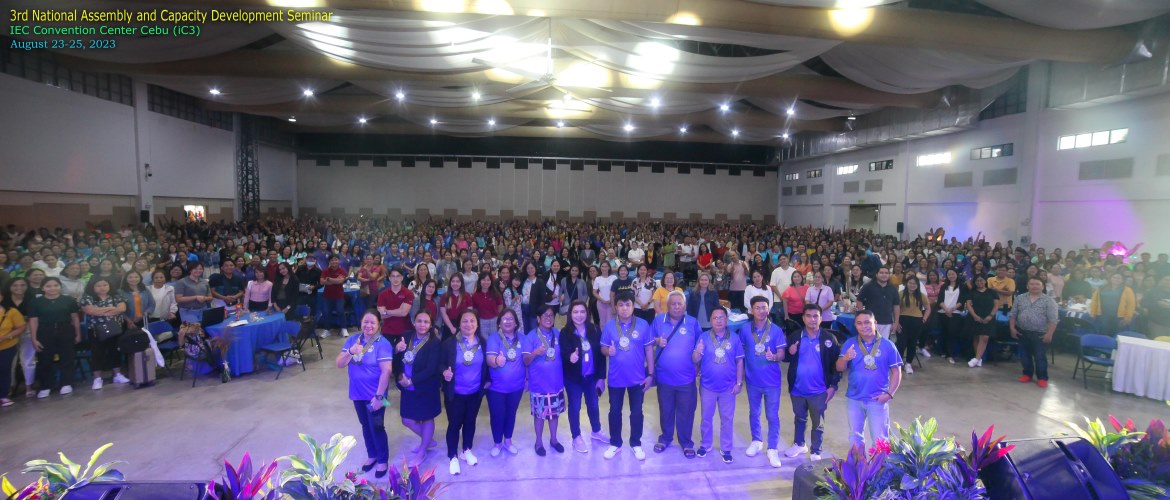
Third National Assembly
23–25 April 2023
IC3 Convention Center
Cebu City
The Third National Assembly further expanded the Association's national presence and served as another milestone in promoting continuing professional education among Senior Bookkeepers. The Assembly strengthened inter-regional collaboration and encouraged the exchange of best practices in government accounting, budgeting, treasury operations, and financial reporting.
Fourth National Assembly
27–29 April 2024
Ynares Sports Arena
Pasig City
The Fourth National Assembly highlighted the growing influence of the Association as a recognized professional organization of DepEd school finance personnel. It provided a strategic platform for discussing organizational reforms, policy recommendations, and the continuing professional development of members while strengthening partnerships with government agencies and stakeholders.
Fifth National Assembly
23–25 April 2025
Grand Menseng Hotel
Davao City
The Fifth National Assembly reinforced the Association's commitment to advocating for the welfare and professional recognition of Senior Bookkeepers assigned in Implementing Units. Discussions during the Assembly increasingly focused on career progression, organizational restructuring, and strengthening school financial governance throughout the Department of Education.
Sixth National Assembly and Capacity Development Seminar
15–17 April 2026
Paradise Garden Resort Hotel and Convention Center
Boracay Island, Malay, Aklan
The Sixth National Assembly represented another defining milestone in the Association's history. Conducted together with a Capacity Development Seminar, the event gathered hundreds of school finance professionals from across the country to participate in technical sessions, policy discussions, and leadership development activities.
The Assembly also reaffirmed the Association's advocacy for strengthening the School Finance Service in the Department of Education, including the promotion of professional excellence, organizational reform, and the proposed career progression for Senior Bookkeepers assigned in Implementing Units.
Looking Back, Moving Forward
From a modest gathering of pioneering regional leaders in Legazpi City in 2019, the Association has grown into a truly national organization representing Senior Bookkeepers from all regions of the Philippines. Each National Assembly has strengthened the bonds among its members, expanded opportunities for professional growth, and reinforced the Association's role as a constructive partner of the Department of Education in advancing transparent, accountable, and effective school financial management.
The history of the National DepEd Senior Bookkeepers Association is therefore more than a chronicle of meetings and assemblies. It is the story of a profession that found its collective voice, united around a common purpose, and continues to advocate for excellence in public financial management in support of quality basic education.
|